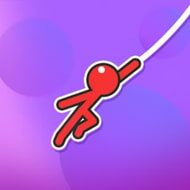
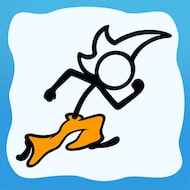
You let go of the rope half a second too late, and instead of sailing over the gap your stickman drops straight into it like dead weight. That delay is the entire lesson of Stickman Hook, repeated across a hundred-plus stages until the timing clicks and swinging feels like control instead of luck.
The Timing Behind Every Stickman Hook Swing
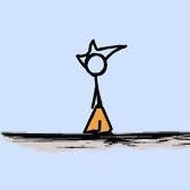
Tap to fire a hook at the nearest anchor, hold while your stickman arcs like a pendulum, then release toward the next point or the flag. The rope reels in as you hold it, so longer holds mean a tighter arc. Release at the peak and you soar; too early and you drop; too late and you snap back into the gap.
Beginners often hold the hook too long because it feels safer, but Stickman Hook punishes over-holding as hard as an early release. The sweet spot is the instant your stickman is rising and forward-facing, not right after you attach. Once that rhythm sinks in, chaining hooks without touching ground stops feeling accidental.
Players hunting for more distance land on the answer regulars already know: momentum carries between swings, so a clean release matters more than grabbing the closest anchor. A farther point at the right angle, even if riskier, often beats a safe short hop that kills your arc.
Why the Flop Still Gets People
Miss a hook and ragdoll physics take over, sending your stickman into a floppy tumble players just call the flop. It barely punishes you since you simply restart the level, but the animation is funny enough that some players miss hooks on purpose just to watch it.
Where the Stickman Hook Difficulty Curve Actually Bites
The first levels are practically tutorials, with anchors close together and gaps forgiving enough that a mistimed release rarely ends a run. That changes fast: gaps widen, anchors sit at awkward angles that force a mid-air read instead of a memorized pattern, and deep in, a bad release means restarting from your last cleared flag.
This escalation rarely comes from new mechanics bolted on — it’s the same hook, same swing, same window, just tighter and less forgiving. That consistency is why the game holds attention across a hundred-plus stages instead of feeling gimmicky by level thirty.
Speedrunners gravitate here since a clean run is about minimizing wasted swings, not memorizing hazards. Completionists chasing all 23 skins have a rougher time, since those unlocks require surviving the stretch where error margins are smallest.
Skins, Milestones, and the Grind Toward the Later Levels
Cosmetic unlocks work a few ways. Many skins come from level progression, so clearing milestones hands you a new look automatically. Others, like the burger, cactus, dragon, and robot stickmen, come from watching short videos, and a rotating weekly selection adds a few random options.
That mixed system is one of the more debated parts of the game. Plenty of players enjoy filling out the skin roster alongside clearing levels, but the video-gated unlocks feel like padding once level skins run out and new looks require watching rather than swinging.
Casual players who just want to beat whatever level is open tend not to mind, since skins are optional and never affect how far a swing carries or how forgiving a hook feels. The cosmetic layer sits apart from the physics, keeping the game honest even when unlocks feel like a detour.
What Regular Players Notice After a Few Dozen Runs
One detail that only shows up after enough runs is how much the camera telegraphs upcoming anchors a beat early, which experienced players use to plan a release two swings ahead instead of reacting one hook at a time. New players rarely notice this, still focused on the hook they just fired.
The community vocabulary here is small but consistent: chaining momentum, the flop, getting flag-blocked when a finish point sits just out of reach. None of it is complicated, fitting a game that’s really just one mechanic pushed as far as it can go.
Stickman Hook earns its long sessions less through variety and more through how satisfying a well-timed chain of releases feels once your hands catch up to the physics — and that feeling, more than any fear of the flop, is why one short session keeps stretching into ten more attempts at the flag that stayed just out of reach.